Matthew Corbin Bishop
PAST BORDERS | PRESENT ORDERS
3 - 23 November 2026
REDRAWING HISTORY, 1859 TO TODAY
‘One of the first things I ever bought was a globe. I was seven. My childhood was spent surrounded by symbols
of nations: atlases, books of flags and maps of the world, which I would sketch. I learned every world capital,
every flag, and collected as many currencies as possible.
The work in this exhibition stems from that love of nations. It is a project that has been a focus for over 15
years: The Making of the Modern World, the postage stamp as the central element of reimagining the world
through visual currency.
Throughout this time, I read extensively to develop an understanding of Europe and the Ottoman (Turkish)
Empire’s colonial history, and as the project advanced, my research informed new ideologies and ways of
working. At the core of this is the notion that nationality and patriotism – whilst unifying in ways – are also
drivers of extremism and the creation of ‘the other’.
From an initial grouping, ‘The British Empire’ show at the Truman Brewery in July 2008, I made 80 stamps
representing countries that became colonies, dominions and protectorates of the British Empire at its peak,
from pre-World War I to post-WWII.
The exhibition was a comment on the breadth and influence of Britain’s colonial past; a past that is often
overlooked, incredibly, by our schooling system. Instead, the focus of history teaching in UK schools has been
around our oppressors, our colonists. This project supported my education of a subject I felt was imperative.
It clarified a period of our history that is key to understanding Britain’s position and how its global relations
are shaped today.
Postage stamps are undoubtedly beautiful things. Taken at face value, they are intricate and dazzling
snapshots of what seems a bygone era; but stamps are, of course, also a monetary structure. Britain’s
involvement in these countries was almost always transactional and exploitative, as ‘free trade’ spread
across the colonies.
For this exhibition, I have paired two periods – two sets – that at first seem to share a tenuous link. The first
set is a collection of gouache paintings on flat-bed paper from the mid-19th century. The period that these
stamps originate from depicts Europe in 1859, when Germany and Italy were yet to unite: a world of splintered
duchies and principalities, larger kingdoms, and the odd republic. To this European order, which had held sway
for centuries, an abrupt change was coming. Nationalism was coming to Germany and Italy and, with it, a mad
dash and perceived need to catch up with the colonial projects of their fellow European nations.
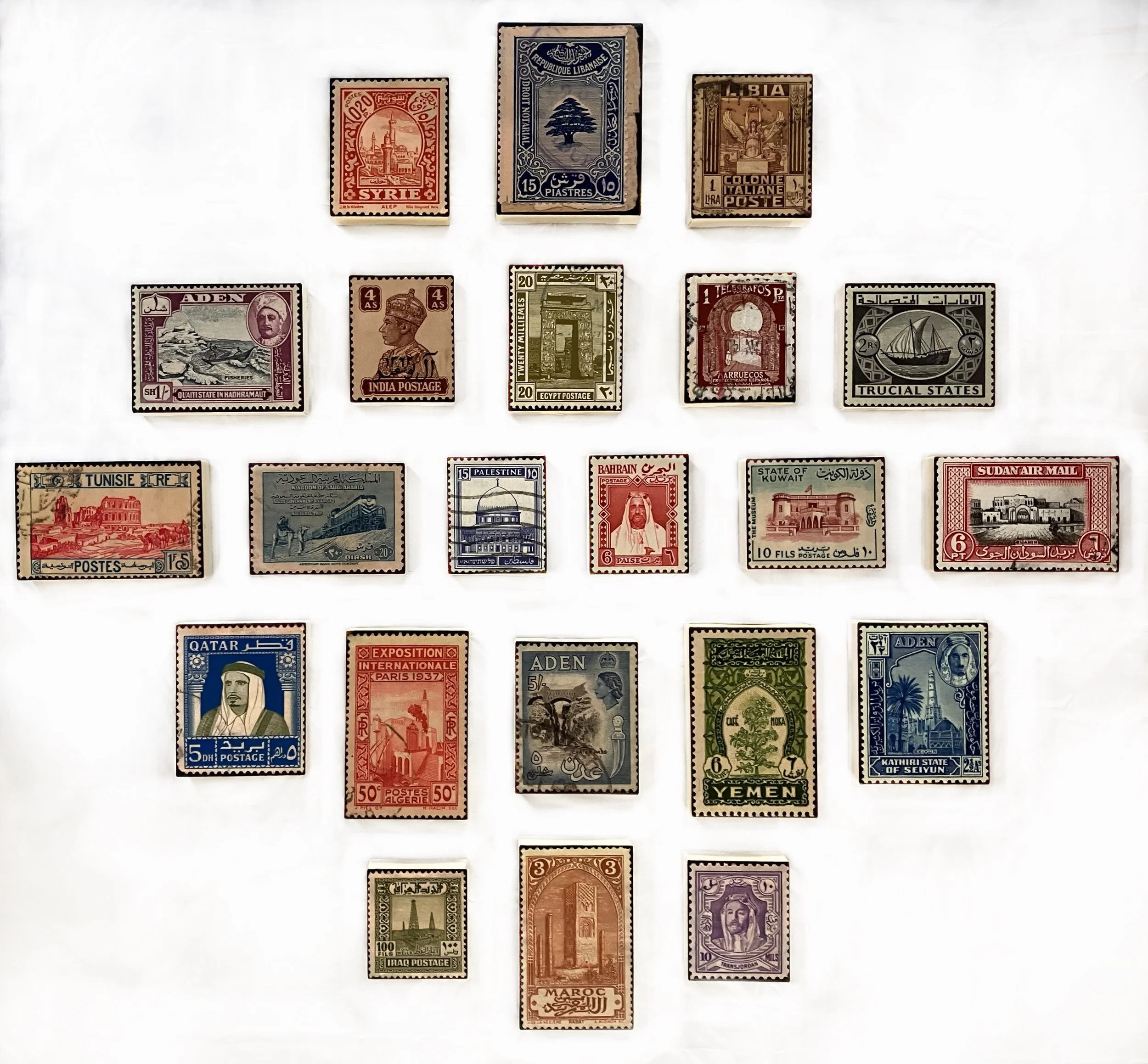
The second set is of the Middle East after the Great War. It was this aspiration to join the theatre of the great
European Empires – especially France and Great Britain – that led to the dismantling of the Ottoman Empire
once and for all, culminating in the tragic policies that have blighted the Middle East since. These events still
scar our tumultuous present.
Some of the most intractable issues of our time stem from the arbitrary division of the Ottoman Empire’s
territories and continue to disrupt the balance of these states and their peoples.
My hope is that this exhibition shines a light on this history, but also that the paintings can be enjoyed in their
own right for what they are: beautiful historical documents and artefacts. Compact vessels of symbolism and
representation, a celebration of what makes our world such a wonderful place. It’s diversity.’
Matthew Corbin Bishop, London, 2026.
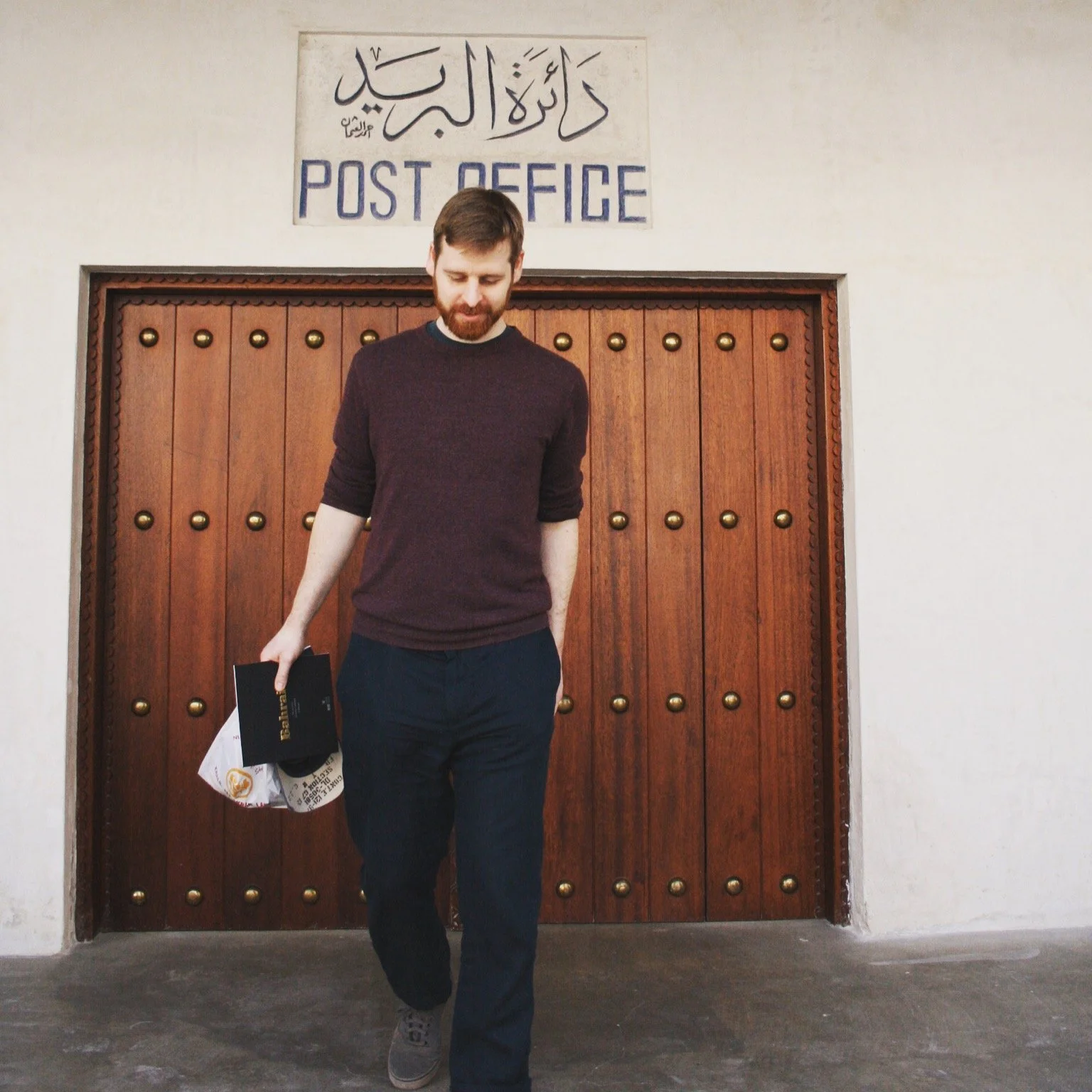
Growing up in Southampton, England’s ‘Gateway to the World’, Matthew Corbin Bishop (b. 1984) developed a fascination with the globe from an early age. As a boy, he memorised every capital city and national flag, while becoming captivated by his grandfather’s extensive stamp collection, which he would later inherit and develop into a collection of his own.
In 2005, Corbin Bishop began studying for a BA (Hons) at Bath Spa University. It was here that he developed his painting practice under the tutelage of Professor Alex Landrum (Bath Spa / Central Saint Martins), whose influence was instrumental in shaping and focusing his work.
While at Bath, Corbin Bishop met the artist Graham Day, who would become a long-term friend and studio partner following Corbin Bishop’s move to London a year after graduating. Day subsequently introduced him to gallerist Rose Issa, with whom Corbin Bishop would collaborate for many years.
Driven by a longstanding interest in geopolitics, Corbin Bishop’s practice is often conceptual, drawing extensively on archival imagery, including historical documents, maps and, in particular, postage stamps. His paintings of stamps have become a central element of his practice for almost two decades, with more than 600 produced to date.
The Making of the Modern World, his ongoing project examining empire and colonialism, was first presented in Control / Art / Delete at the Truman Brewery in London in 2008. The following year, he held his first solo exhibition at Rose Issa Projects, London.
In 2011, Corbin Bishop’s work was selected for Richard of York Gave Battle in Vain, an exhibition curated by Cornelia Parker in collaboration with the Government Art Collection. Opening at the Whitechapel Gallery, London, the exhibition subsequently toured to Birmingham Museum and Art Gallery and the Ulster Museum, Belfast.
In 2014, Corbin Bishop took part in the Alanica Symposium in Vladikavkaz, Russia, a month-long residency and studio programme. The work produced entered the collection of the National Centre for Contemporary Arts (NCCA), Russia.
Corbin Bishop’s work has been exhibited extensively in London, including at The Mosaic Rooms – Al-Qattan Foundation, Dalla Rosa Gallery and the Royal Academy Summer Exhibition. His paintings have also been exhibited internationally in Italy, Lebanon and Kuwait, and presented at art fairs including Istanbul Contemporary, Art Dubai and Art Abu Dhabi.
For his exhibition at Marie José Gallery, Corbin Bishop returns to and reimagines his ongoing project The Making of the Modern World, bringing together two distinct bodies of work. His Europe 1859 gouache paintings will be exhibited in their entirety for the first time, alongside a selection of oil paintings on canvas engaging with the history and political geography of the Middle East.
Together, these works establish a dialogue between two pivotal moments in modern history, tracing the complex political and cultural forces that emerged from them. Through this dialogue, Corbin Bishop reveals the enduring structures and tensions of the past, while considering the ways in which they continue to resonate and shape the world today.
SELECTED WORKS
LOADING SOON
Any of the works speak to you?
Contact us for more inquiries